



As a web designer whose primary client base is largely composed of small businesses, I often “throw graphic design” in the mix as a value-added service at no additional fee or a nominal fee to keep them on board. Now with AI making huge inroads into the profession, I felt compelled to find out just how much.
An Answer to the Collision of Generative AI into the Design Industry
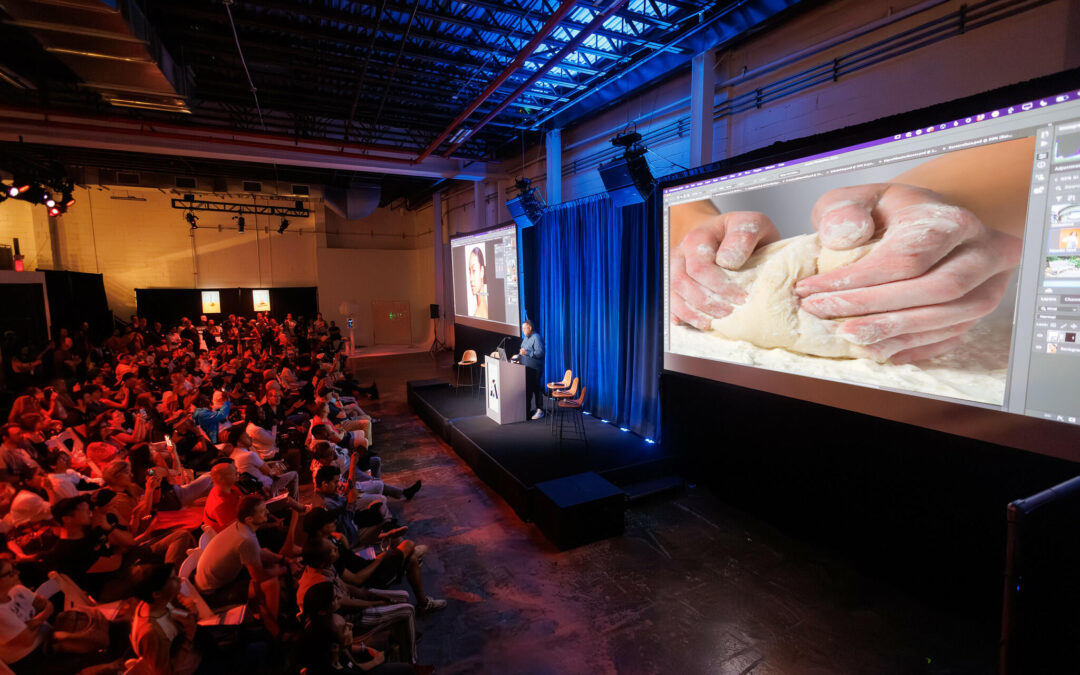
ADOBE – The Birth of AI in Design
In March 2023, Adobe – the world’s premier design and digital document management company introduced its first AI-powered app, Firefly. 2 months later, in May, they injected their new generative AI engine into Photoshop. I gave it a whirl and was impressed. I described the image I desired using text-based prompts, which felt like rolling the dice. It was fun and useful. Today, I use Adobe’s AI engines to “fine-tune” my work, automate large projects, and help with lighting inspiration and creative ideas when I’m shooting blanks.
How is this impacting the design community? I’m not just talking about graphic designers; think architects, engineers, industrial designers, city planners, GIS specialists, e-commerce/online sales professionals, advertising managers . . . the list goes on.
GenAI as an “Assistive Partner,” Not a Replacement: Experienced designers generally do not view GenAI as a threat to their jobs. Instead, they see it as a productivity booster that can handle:
• Repetitive tasks: Generating placeholder text (lorem ipsum replacement), basic layouts, or icon variations.
• Ideation support: Providing a “starting point” to overcome the “blank canvas” problem.
• Synthesizing data: Summarizing user research notes or generating initial user personas.
– From an academic publication, “User Experience Design Professionals’ Perceptions of Generative Artificial Intelligence,” May 11, 2024.
The next summer, Adobe invited local Sacramento-area “power users” to attend its Adobe Creative Summit. Held at Sacramento’s prestigious Elks Tower, attendees were treated to a great spread including mouth-watering appetizers, an open bar, tons of swag, and of course, an interactive conference all about AI in design.
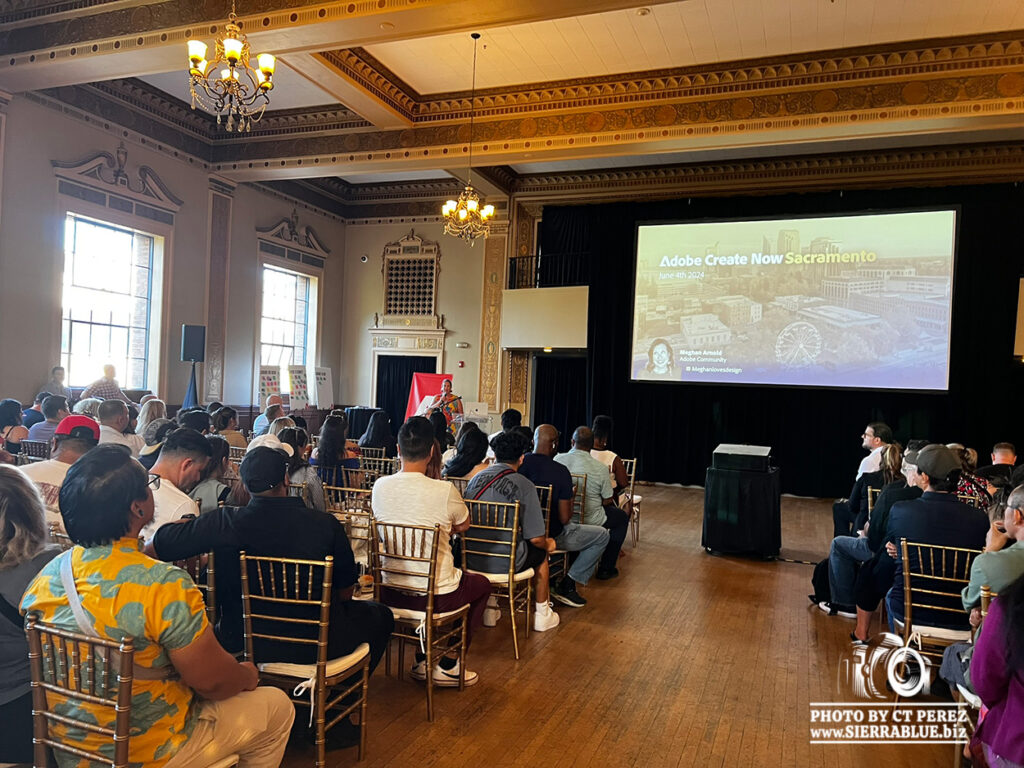
Remember all the fails that early AI generated just a few years ago, such as the six-fingered people? It was kind of like that. In real time, Adobe’s presenters used Firefly to generate images from text prompts that didn’t completely wow the audience, and in fact, ignited soft chuckles from time-to-time. But that was then. Today, generative AI has improved greatly.
As a web designer whose primary client base is largely composed of small businesses, I often “throw graphic design” in the mix as a value-added service at no additional fee or a nominal fee to keep them on board. Now with AI making huge inroads into the profession, I felt compelled to find out just how much.
New York Times columnist Tressie McMillan Cotton, declares, “AI is Pretty Mid.” She writes, “You can’t just learn how to craft a prompt for an AI chatbot without first having the experience, exposure and, yes, education to know what the heck you are doing.”
Hello Google, Whatcha Got?

Prompt: “Is AI taking jobs from graphic designers?”
Gemini produced this response . . .
The short answer is: AI is taking over tasks, not necessarily the entire profession.
As of 2026, the graphic design landscape is undergoing a “silent revolution.” While we aren’t seeing a total disappearance of designers, the job market is splitting into two distinct paths: those who use AI as a high-powered engine and those whose roles (focused on repetitive execution) are being automated away.
The Shift in Numbers (2025–2026)
Recent data shows that AI’s impact is real and measurable:
Declining Roles: Job postings for “execution-heavy” creative roles like production artists and junior UI designers fell by roughly 32.7% in 2025.
Rising Skills: Conversely, job postings requiring AI-specific skills (like AI video editing or AI-assisted design) have surged by over 100%.
The Wage Premium: Designers who can effectively prompt and integrate AI into their workflow now command a salary roughly 23% higher than those who don’t.
A I write this, moments ago, Adobe just launched a new ad campaign for its AI graphics/video engine Firefly. Here’s a screenshot from their FB Page.

Google Ads and AI
I began serving Google Ads (Google AdSense) on my website in 2004. In 2015, I flipped the script and began managing Google Ads and Ad Grants for Nonprofits. On average, I manage roughly $1 million dollars in ad budgets just in the “Google space.” I’ve seen AI enter my field from day one; AI isn’t a new technology, its evolving and at light speed. Here’s a timeline of Google’s implementations of various AI features in the Google Ads platform:
• 2003 (Quality Score): Early algorithmic, data-driven optimization.
• 2007 (Conversion Optimizer): Early automated bidding using historical data.
• 2014-2016 (Smart Bidding & Machine Learning): Google began heavily integrating machine learning for “auction-time bidding” (Smart Bidding) and introduced Responsive
Search Ads (RSAs), which use AI to test ad combinations.
• 2018 (Rebrand to Google Ads): Marked a deeper shift toward an AI-centric, automated, multi-channel platform.
• 2021 (Performance Max – PMax): Launched to fully automate campaign management across all Google channels.
• 2023-2024 (Generative AI): Google introduced conversational AI experiences to help build campaigns, with 84% of search queries projected to be boosted by generative AI, influencing $40 billion in ad revenue.
• 2025 (AI Max): Introduction of “AI Max” for Search, focusing on automated creative and targeting.
Today’s Google Ad platform also includes an AI-assisted asset generator, and it does a great job in just mere minutes – if you know what you want it to do and say. It’s a tremendous virtual partner. 10 years ago, writing ad copy, creating campaigns and assets, etc., could take hours and even days for just 2 campaigns and 8 ads. Those days are behind us. Google’s AI has accelerated the core tasks that advertising professionals are charged with, often down to just minutes.
Here’s a new video commercial I made today for a client – for free, to keep them interested in my services. I wrote the copy, and let Google’s Gemini pretty much do the rest, save the intro bumper, which I “made by hand with Adobe Premiere Pro.”
If I’m going to stay relevant in this field, it appears imperative that I continue learning. At a very young age, my father told me that the quality of one’s question is often more important than the answer. When he attended law school at UCLA, he would come home and play a game with me based on the Socratic method. I was in 4th grade and I loved it. If you’re keeping up with AI news, that’s been the topic du jour – knowing how to prompt intelligently. Stay curious. Critical thinking matters as much as ever in this new world.
Resources
State of AI in the Enterprise
The untapped edge
January, 2026
User Experience Design Professionals’ Perceptions of Generative Artificial Intelligence
May 11, 2024.
Will AI make graphic designers extinct?
April 19, 2025.
Contact Sierra Blue
Mailing Address
P.O. Box 161293
Sacramento, CA 95816
Phone:
(916) 400-9976
Email:
hello@sierrablue.biz
© 2026 Sierra Blue. All Rights Reserved.
EIN: 821022837
Sierra Blue’s Privacy Policy